
March 29, 20261 min153 views
Japan has 5.5 million vending machines standing unguarded on streets 24/7. Why does nobody break them? The answer reveals something profound about social trust.
Read this article to earn +5 MTC
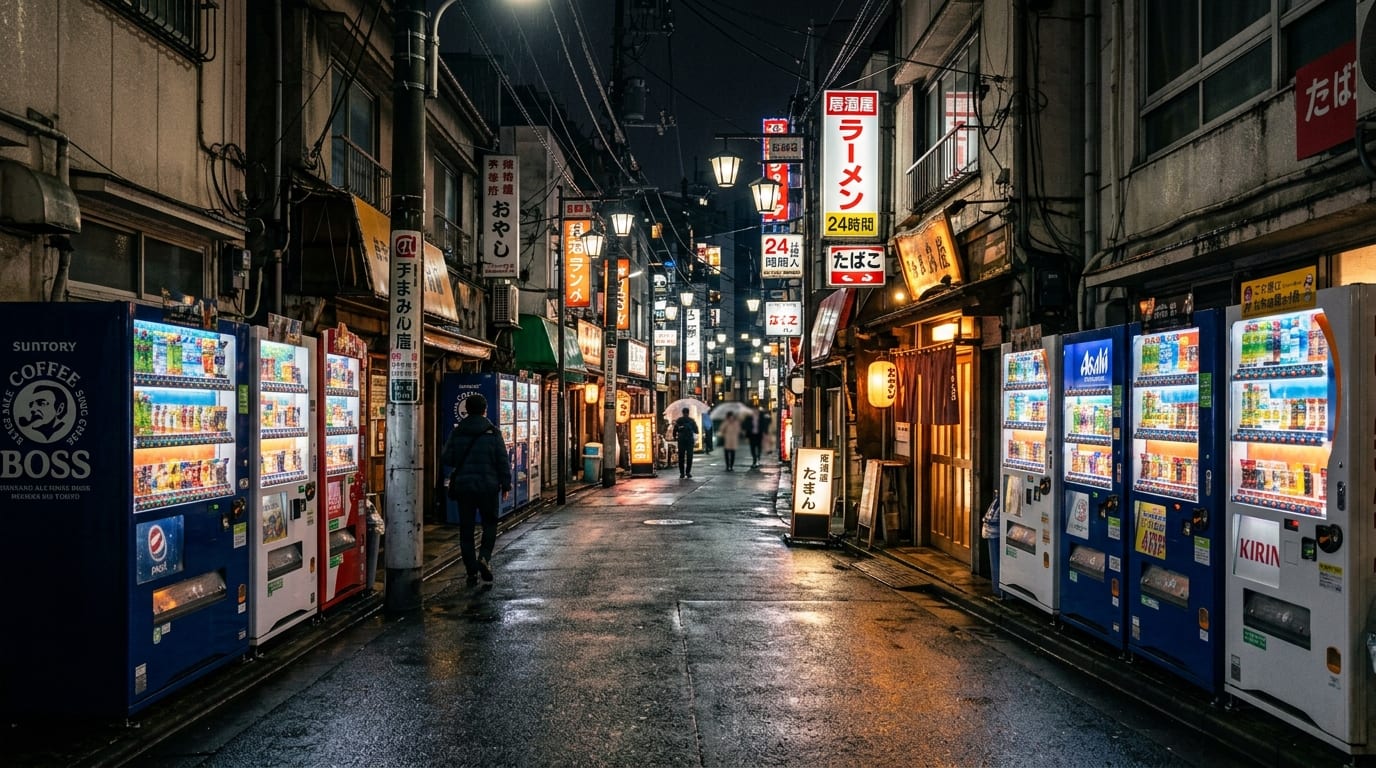
2 AM. A back alley in Shimokitazawa, Tokyo.
On a dark, deserted street, three vending machines glow brightly in a row. Canned coffee, tea, juice. Insert coins, get products. No security cameras. No guards. No chains or locks.
Lucas, visiting from Brazil, stood frozen at the sight.
"Don't these get vandalized?"
For Lucas, the question was perfectly reasonable. In Sao Paulo, the machine would be destroyed overnight — cash stolen, products gone. Parts of New York, same story. Even London carries risk for unguarded cash-collecting machines on public streets.
Yet Japan has approximately 5.5 million vending machines. One for every 23 people — an unmatched density worldwide. Operating 24/7, unmanned, everywhere. Office districts. Residential corners. Mountain campsites. The fifth station of Mount Fuji. Island harbors.
During his three-week trip, Lucas started counting. Three to four machines per Tokyo block. Over ten inside train stations. Vending machines standing right next to convenience stores (why?).
One night, hiking back from a mountain trail in Nara, he spotted a lone vending machine glowing in the darkness. The nearest house was 500 meters away. Nothing around but deer and insects. That machine was full of coins. Not a single scratch on it.
Lucas first assumed it was because Japan is safe. True, crime rates are low. But he realized that alone doesn't explain things.
Other countries are safe too. Iceland, Switzerland, Singapore. None of them have vending machines at anything close to Japan's density. Norway has low crime, but nobody puts a cash-filled machine on a midnight mountain road.
Safety alone doesn't produce the number 5.5 million.
Lucas researched Japanese vending machine history and was stunned by the product variety. Not just beverages — oden stew, cup noodles, bananas, eggs, rice, flower bouquets, omamori charms, fortune slips, rhinoceros beetles, and even car tires have been sold via vending machines.
Why do Japanese people try to sell everything through machines?
A vending machine company salesman Lucas met in Tokyo offered an insight: "There's no human between the customer and the product. That's the appeal. Japanese people sometimes don't want social friction when buying things. Late at night, wanting ice cream, some people feel self-conscious with a convenience store clerk watching. A vending machine means no one sees you. No one is inconvenienced."
Interesting, Lucas thought. But something still didn't click.
Then one day, talking with Mikko, a Finnish traveler at his Osaka guesthouse, the puzzle came together.
"Finland has vending machines too," Mikko said. "But they get smashed regularly. The problem is that the person who breaks one thinks of themselves as anonymous — disconnected from consequence. In highly anonymous societies, vending machines become targets."
Lucas pushed back. "Tokyo is anonymous too. Fourteen million people."
Mikko shook his head. "It's anonymous, but Japanese people don't change their behavior when they're anonymous. Even when no one's watching, they follow the same rules. That's the difference."
A midnight mountain road. Only deer around. A vending machine without a single scratch.
That machine survives not because its lock is strong. Not because of surveillance cameras. It survives because in this country, tens of millions of people behave the same way whether anyone is watching or not.
Those 5.5 million vending machines aren't products of technology. They are trust infrastructure. An invisible promise standing visibly on the street. If this society's trust ever fractures, vending machines will be the first to break. And as long as they keep glowing peacefully, the trust holds.
On his last day, heading to Narita Airport, Lucas bought one final canned coffee from a rural roadside machine. 120 yen. Warm.
"Behind this 120-yen can," Lucas thought, "lies an extraordinary promise — tens of millions of people choosing to do the right thing, even when absolutely no one is watching."