
March 29, 20261 min139 views
The sight of Japanese commuters sleeping on trains baffles visitors. The answer reveals a society built on decades of cultivated trust.
Read this article to earn +5 MTC
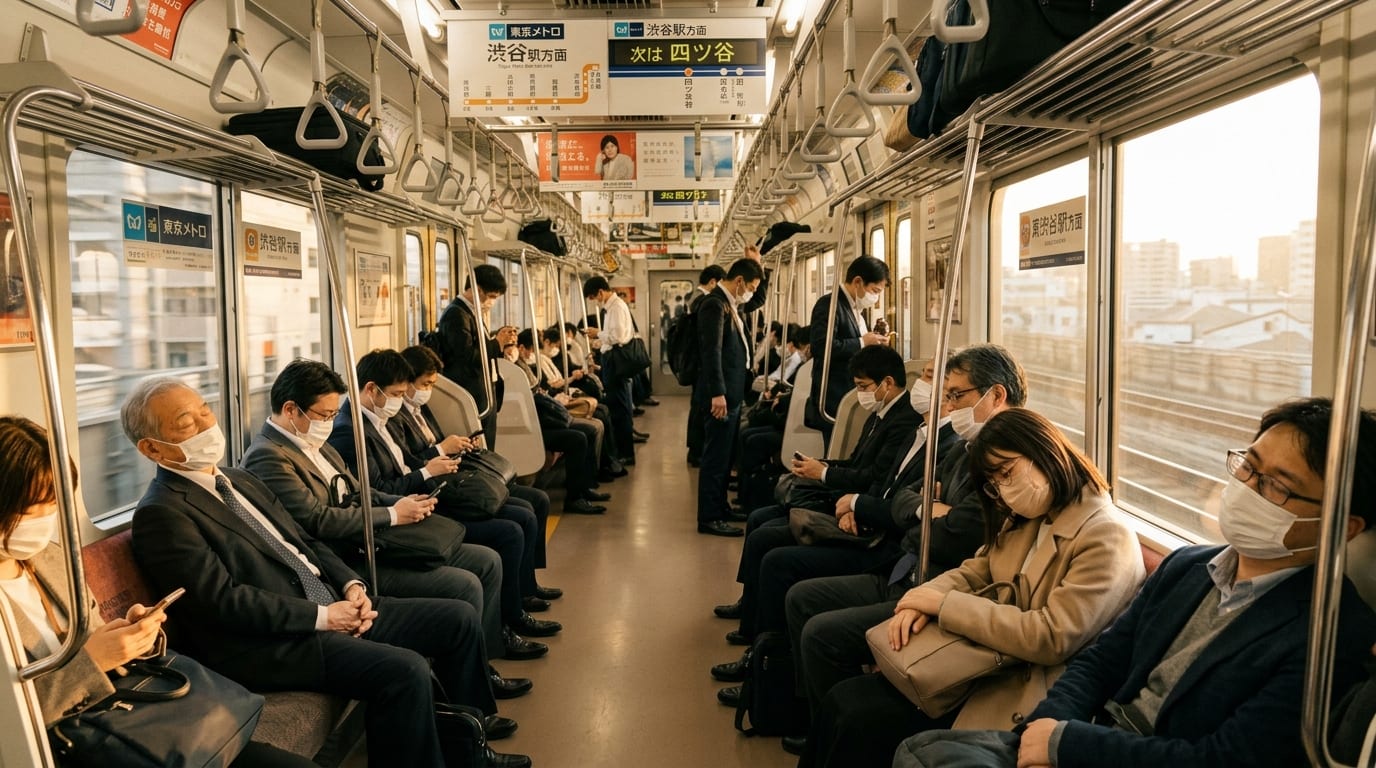
7:48 AM. Tokyo Metro Marunouchi Line.
Sarah, an American, was riding the Tokyo commuter train for the first time. She was used to the New York subway — the crowds, the noise, someone shouting into their phone. But what froze her on that Tokyo train was something she never expected.
The businessman next to her slowly closed his eyes. His head tilted, and he was completely asleep. Across the aisle, a college student with earphones was fast asleep, mouth slightly open. The elderly woman beside her was dozing too, clutching her shopping bags, breathing steadily.
Sarah looked around the car. Six out of ten people were sleeping.
"...Is this normal?"
Falling asleep on the New York subway is asking for trouble. Your bag gets stolen. Your pockets get picked. Worst case, you get assaulted. In London, Paris, anywhere — losing consciousness on public transit means danger. Every safety rule Sarah had ever learned was screaming inside her head.
But in Tokyo, nobody seemed to care.
Sarah started observing the trains. By the third day, she noticed: sleeping passengers left their bags loosely on their laps. Some had wallets half-visible in their pockets. But nobody — absolutely nobody — touched them.
A week later, she noticed something else. Sleepers woke up right before their stop, as if they had built-in GPS. When she asked her Japanese colleague, he laughed. "Yeah, I oversleep sometimes, but usually I wake up."
"But doesn't anyone steal your stuff?" Sarah asked. Her colleague looked momentarily confused. "Steal what?"
That reaction said everything.
Sarah dug deeper. Train crime rates in Japan are dramatically lower than in any major world city. But that alone doesn't explain why people sleep. Other countries are safe too. Switzerland, Singapore — both have low crime. But nowhere else do sixty percent of passengers sleep simultaneously.
One evening, Sarah struck up a conversation with a man in his sixties sitting beside her. He spoke a little English and said something fascinating.
"Japanese people don't trust strangers. They trust the system."
Sarah tilted her head.
"Everyone knows that even while they sleep, the people around them will continue behaving normally. It's not about believing in individuals — it's about believing that everyone in this space operates by the same rules. That's why they can close their eyes."
That night, Sarah wrote in her notebook:
"In New York, staying awake on the train is self-defense. In Tokyo, sleeping on the train is a silent declaration that you belong to this society. Sleepers aren't vulnerable — they're expressing trust with their bodies."
Three months into her Tokyo life, Sarah finally dozed off on the train herself. Fifteen minutes from Ikebukuro to Shinjuku. When she woke up, her bag was on her lap. Wallet and phone, untouched.
In that moment, she understood: being able to sleep on the train meant she had been accepted into this society.