March 29, 20261 min139 views
A French tourist left a generous tip at a Kyoto restaurant and was chased down the street to return it.
Read this article to earn +5 MTC
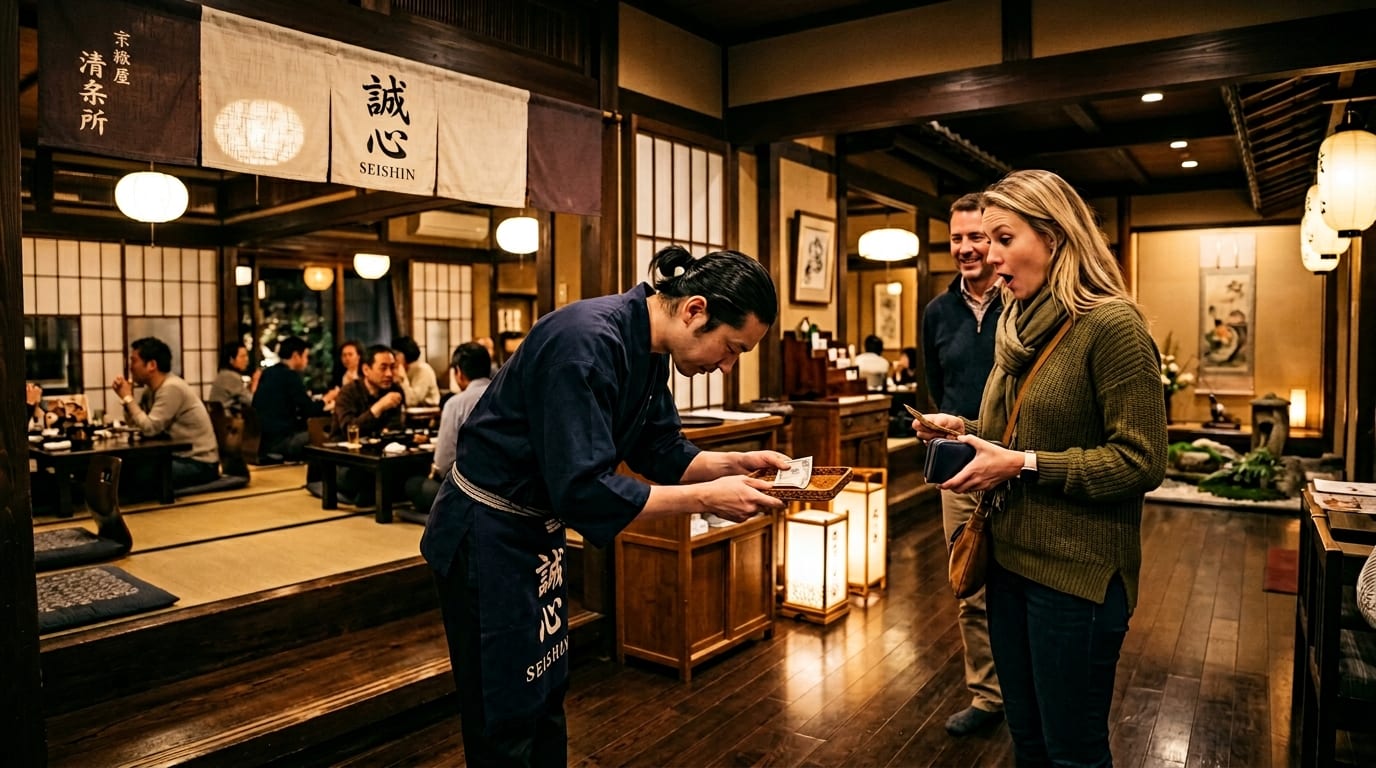
Kyoto, Gion district. A century-old ryotei restaurant.
Marie, from France, was speechless at the dishes before her. Hassun, owan, mukozuke, yakimono, nimono — each plate was a work of art. The choice of pottery, the angle of presentation, even the pickled red turnip served as a palate cleanser — everything communicated intentionality.
The okami's service was flawless. The timing of each course, the removal of each plate. The moment Marie set down her chopsticks, the next dish appeared. When conversation was flowing, the okami waited silently. As if synchronizing her breathing with the guests.
After two hours, Marie was moved. She had trained at a three-Michelin-star restaurant in Paris, yet this hospitality was on another level.
The bill came to 30,000 yen. Without hesitation, Marie added a 5,000 yen tip. In France, exceptional service deserves monetary appreciation. It's a sign of respect.
The okami looked at the money on the tray and froze for a moment. Then, with great care, she returned the 5,000 yen note.
"This won't be necessary."
Marie was confused. Was the amount wrong? Had she been rude? Was it too little?
"No, this is for you. A thank-you for the wonderful service."
The okami simply smiled. "Your kind words are more than enough. Knowing you enjoyed the meal — that is our greatest reward."
That night, Marie sat in her hotel room, thinking.
The next day, she went to a takoyaki stand in Osaka. Eight pieces for 400 yen. The man behind the grill flipped each ball with practiced precision. While eating the piping-hot takoyaki, Marie handed over a 500 yen coin and said, "Keep the change."
The man grabbed the 100 yen coin and chased after her. "Miss! Your change! You forgot your change!"
Day three. A Tokyo cafe. Marie ordered a latte. The young barista crafted beautiful latte art. Marie left 500 yen on the table and walked out. Thirty seconds later, the barista came running after her. "Excuse me! You forgot something!"
At this point, Marie could only laugh. Three consecutive tip rejections. But a question wouldn't leave her mind.
Why? Is there a human being alive who doesn't want extra money?
Marie returned to Kyoto and wrote a letter to the ryotei's okami, asking why she wouldn't accept a tip. A week later, a carefully written response arrived.
The okami wrote:
"For you to enjoy our food and hospitality — that is our work and our joy. If we accepted money beyond the bill, our work would become 'for the money.' Then it would no longer be pure omotenashi."
"I understand that in France, money is an expression of gratitude. In Japan, it is the opposite. Not accepting money is our expression of gratitude. It means: 'Serving you is itself the reward.'"
Marie read the letter again.
In French service culture, a tip completes the transaction. Good service earns additional payment. The "default state" of service is incomplete — the tip finishes it.
But in Japan, service is already complete from the start. It's not that the tip is included in the price. It's that money is irrelevant to the purpose. Hospitality exists as its own complete act. Offering a tip inadvertently says, "What you did wasn't enough."
Back in Paris, Marie told her junior colleagues at the culinary school:
"When that takoyaki man in Osaka chased me down the street to return 100 yen, I didn't understand. Now I do. He was saying: 'My takoyaki is perfect at 400 yen. There's no reason to pay more.'"