
J-Times Editorial
Culture Desk
Just inside every Japanese front door runs an invisible line — cross it in your shoes and you have missed something quietly important. Meet the genkan, and discover why taking your shoes off is, at heart, an act of respect for the home that welcomes you.
Read this article to earn +5 MTC
Why Do Japanese Take Their Shoes Off? The Genkan Explained
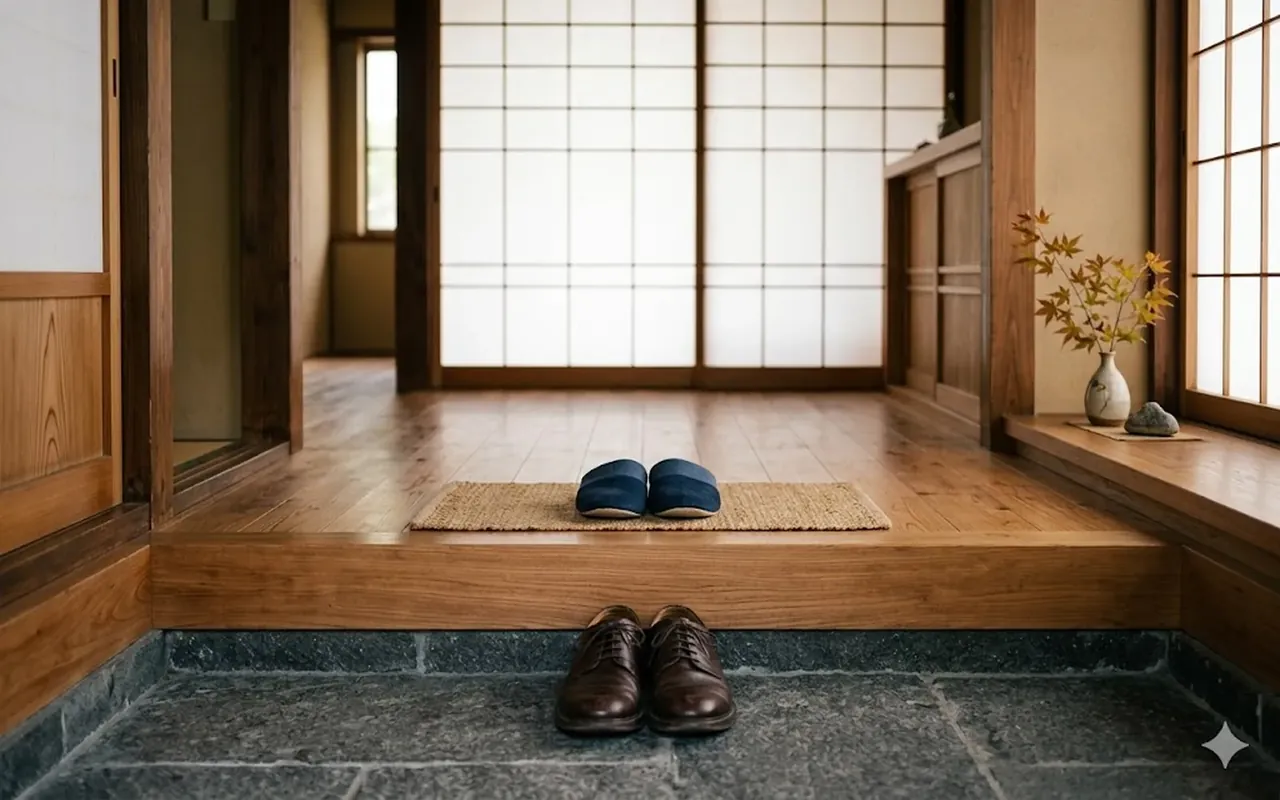
Just inside almost every Japanese front door runs a line you cannot see. On one side sits a low tiled landing scattered with shoes; on the other, a floor raised a hand's width higher, swept and waiting. Step up with your shoes still on, and a host will gently stop you — not because you have offended anyone, but because you have crossed a threshold without noticing it was there. That step is called the genkan (玄関), and learning to read it is one of the quietest, kindest ways to understand Japan.
The reason is simpler than it looks, and here is the "aha": in a Japanese home, the floor is where life happens — you sit on it, eat beside it, and unroll your bed onto it at night — and the door marks a line between a clean "inside" and a dusty "outside." Once you see the floor as living space rather than a surface to walk over, taking your shoes off stops being a curious rule and becomes the only thing that makes sense. It is, at heart, an act of care: respect for the home, and for the host who keeps it clean for you.
TL;DR
- Floors are for living on — people sit and sleep on tatami and futon, so the floor must stay clean enough to lie down on.
- The genkan marks the boundary between outside (soto) and inside (uchi); shoes belong to the outside, and so does the dust they carry.
- It's reinforced by a wet, muddy climate and old ideas of purity and cleanliness — making shoes-off a gesture of respect, not just hygiene.
なぜそうなったのか — Why the rule runs so deep
Three threads braid together into a single, sensible knot:
- You live on the floor. Traditional Japanese rooms are floored with tatami (畳) mats. People sit directly on them, eat at low tables, and roll out a futon (布団) to sleep at night. When the same floor is your chair by day and your bed by night, tracking in street grime is unthinkable — you would be walking the pavement across your own pillow.
- A wet, humid climate. Japan's long rainy season and rice-paddy landscape historically meant a great deal of mud and moisture. Leaving all of it at the door protected both the home and the tatami, which scuffs and stains all too easily.
- Purity and the inside/outside line. Shinto-influenced ideas prize cleanliness and the avoidance of defilement (穢れ, kegare). Married to the social sense of uchi/soto (内/外, inside/outside), the home interior became a protected, "clean" world — and the genkan the gentle gate that guards it.
歴史 / How the custom formed
- Ancient–classical Japan: Raised wooden floors and, later, tatami turn the interior into something you meet with your whole body, not just your feet.
- Medieval period: The term genkan originates in Zen Buddhist temple architecture before spreading to ordinary homes — the entrance reimagined as a meaningful threshold, a place to leave the world behind.
- Edo period onward: Tatami-and-futon living becomes widespread, and slipping off your footwear settles into ordinary household manners.
- Today: The rule reaches far beyond homes — into many schools (with their indoor shoes, uwabaki), traditional inns (ryokan), clinics, and a good number of offices and eateries.
実際のところ — How to do it right
The genkan does all the work for you. It's a small lowered floor at the entrance; the step up to the main floor is the boundary, and once you spot it, the rest is easy.
- Take your shoes off in the genkan, standing on the lower level. Step up onto the raised floor in socks or slippers — never let an outdoor sole touch the inside floor.
- Turn your shoes to face the door. After stepping up, kneel briefly and point your toes back toward the exit. It looks tidy, makes leaving effortless, and is a small courtesy your host will notice.
- House slippers are for floors — not tatami. Wear the slippers offered to you on wooden or tile floors, but step onto tatami in socks only (no slippers) — the soft mats are treated almost like a bed.
- Mind the toilet slippers. Many homes and inns keep separate slippers used only inside the toilet. Switch into them there — and, famously, don't forget to switch back. Padding into the living room in toilet slippers is the classic, harmless visitor blunder, and everyone has a story about it.
- Watch for the signal. A step up, a waiting row of slippers, or shoes lined up by the door all quietly say the same thing: "leave them here."
ありがちな誤解 — Common misunderstandings
- "It's only about dirt." Cleanliness matters, but so do floor-based living and the symbolic uchi/soto boundary — this is culture, not merely hygiene.
- "Socks don't matter." They're on full display the moment your shoes come off, so clean, hole-free socks are quietly part of the etiquette.
- "Slippers go everywhere inside." Never on tatami — and toilet slippers stay loyally in the toilet.
- "Only old homes do this." The newest apartment in Tokyo has a genkan too; the custom is alive, well, and very nearly universal.
FAQ
Q. Do I really have to take my shoes off everywhere? A. In homes, ryokan, many schools and clinics, and some restaurants — yes. Look for a genkan, a step up, or waiting slippers. When in doubt, simply do what everyone around you is doing; no one expects you to know by instinct.
Q. What's the deal with separate toilet slippers? A. The toilet is considered a less "clean" zone, so dedicated slippers stay there. Change into them on the way in and back out again — leaving in toilet slippers is a common, gently embarrassing mistake that hosts forgive with a smile.
Q. Can I wear slippers on tatami mats? A. No. Step onto tatami in socks (or bare feet). Slippers are for wooden or tile floors only — the tatami is treated with the same care you'd give a freshly made bed.
まとめ / Next reads
Taking your shoes off was never a quirky rule. It is the natural result of a culture that lives close to the floor, treasures cleanliness, and draws a quiet line between the world outside and the home within — a small daily gesture of respect for the space, and the people, who welcome you in. So when you find that step just inside the door, you'll know exactly what to do: spot the genkan, step up clean, and you've understood Japan.
- Related: The Complete Guide to Japanese Etiquette (Dos & Don'ts)
- Related: Onsen Etiquette: Rules, Tattoos & How to Bathe
- Related: Honne and Tatemae: The Japanese Art of Reading the Air
Sources: general references on the genkan, tatami/futon living, the concept of kegare (purity) in Shinto, and uchi/soto in Japanese social space. The Zen-temple origin of the term "genkan" is widely cited (諸説あり on details). Add primary citations before publishing.
Written by
J-Times Editorial
Culture Desk